🐾 Predator–Prey Gridworld Environment




A discrete, grid-based multi-agent predator–prey environment built as a controlled, interpretable, and reproducible testbed for studying coordination, pursuit–evasion, and emergent behavior in Multi-Agent Reinforcement Learning (MARL).
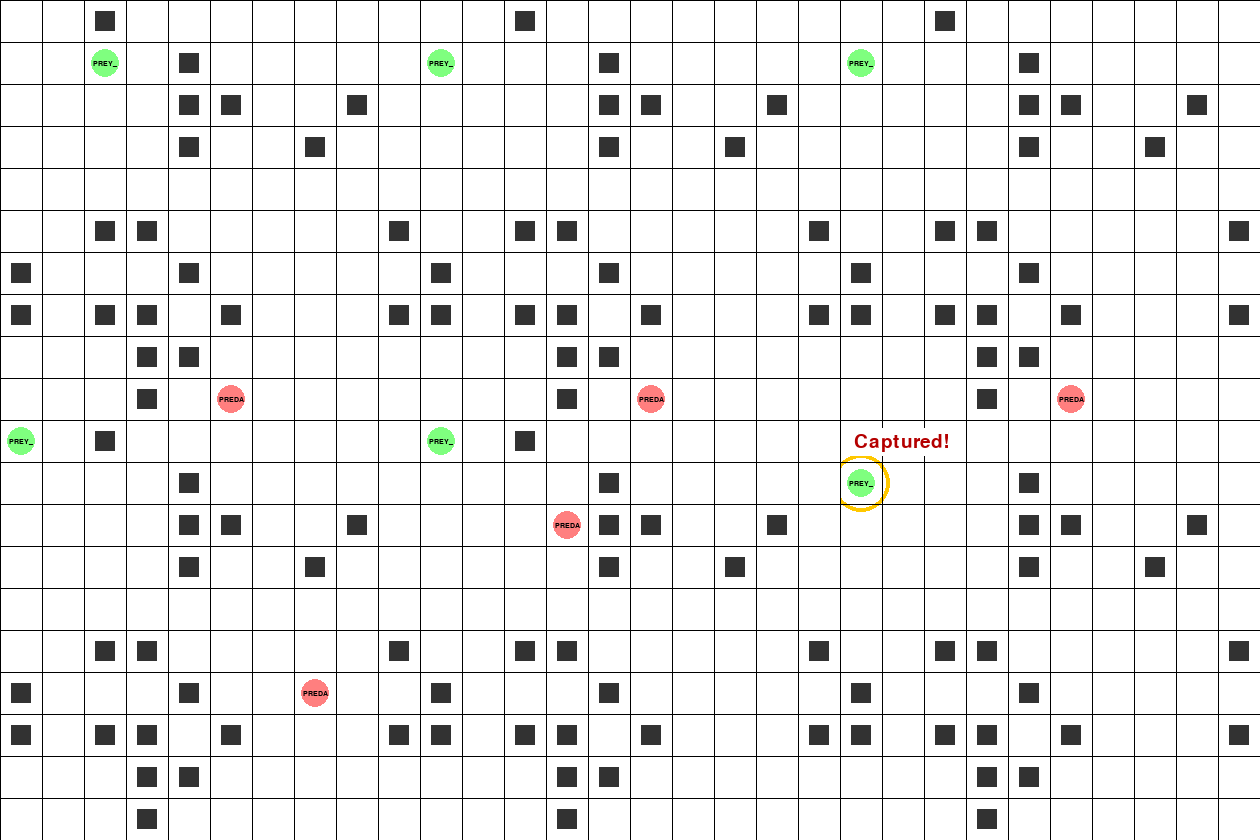
A trained DQN predator (speed 2) running down a speed-1 prey around obstacles until capture (plug-and-play/configs/dqn_1v1).
Start here: the learning path
This documentation is written to take an undergraduate from first principles all the way to running and extending real experiments. Read it in this order:
flowchart LR
    T["1 · Theory<br/>RL & MARL foundations"] --> C["2 · Concepts<br/>the environment"]
    C --> A["3 · Architecture<br/>how it fits together"]
    A --> I["4 · Implementation<br/>algorithms & code"]
I --> E["5 · Examples<br/>tutorials & guides"]| Step | You will learn | Start with |
|---|---|---|
| 1. Theory | MDPs, the Bellman equation, Q-learning, then what changes with many agents | RL Foundations → MARL Theory |
| 2. Concepts | The gridworld, agents, observations, rewards, actions, wrappers | GridWorld |
| 3. Architecture | The layered design and how a step flows through it | Architecture |
| 4. Implementation | How each learning algorithm works, with code pointers | Algorithms |
| 5. Examples | Train, watch, interpret, and extend an experiment | First Experiment |
New to the project? The Student Reading Guide gives a week-by-week path.
What this project optimizes for
- Interpretability — state and action spaces are small and fully enumerable, so every transition, reward, and capture can be traced by hand.
- Modularity — observations, rewards, action spaces, and algorithms are independent plugins wired through registries; swap one without touching the rest.
- Reproducibility — an experiment is fully determined by a YAML config plus a seed: identical configuration yields identical trajectories.
These fold into one governing balance — accessible by default, versatile by
design: plug-and-play/ scripts and YAML configs get you running in minutes
(accessibility), while every axis of the experiment — what agents see, what
they optimize, how they act, and how they learn — is an open plugin surface
awaiting your own observation builders, reward terms, action spaces, and
algorithms (versatility). The registry pattern bridges the two: a plugin
registered once is a one-line YAML option forever. See
Design Philosophy for the full extension menu
with difficulty ratings, plus a
four-scenario showcase
ranging from a 1v1 chase to 5 predators and 20 prey on a 100×100 grid.
It is a controlled laboratory for understanding MARL, not a high-performance training platform. See the Mission for the full rationale.
Quick start
git clone https://github.com/UHUMALAB/PPAGE.git
cd PPAGE

python -m venv .venv
source .venv/bin/activate        # Windows: .venv\Scripts\Activate.ps1

pip install -e ".[baselines]"

# Train the default experiment (3 predators vs 3 prey, IQL)
python plug-and-play/scripts/run_from_config.py
Minimal example
from ppage.core.gridworld import GridWorldEnv
from ppage.core.agent import Agent

# Agent(agent_type, agent_team, agent_name)
predator = Agent("predator", "predator_1", "Hunter")
prey = Agent("prey", "prey_1", "Runner")

env = GridWorldEnv(agents=[predator, prey], size=8, seed=42)

obs, info = env.reset()
done = False
while not done:
    actions = {"Hunter": 4, "Runner": 4}          # 4 = NOOP for every action space
    out = env.step(actions)                        # returns a dict, not a tuple
    done = out["terminated"] or out["truncated"]

env.close()
See the Quickstart for a full install → train → evaluate walkthrough, and the First Experiment tutorial to watch agents learn.
Citation
If you use this environment in your research, teaching, or projects, please
cite it. The repository ships a machine-readable
CITATION.cff;
BibTeX equivalent:
@software{ppage,
  author       = {Muhammad Ahmed Atif and Nehal Naeem Haji and Muhammad Affan and Areesha Kashif and Musab Kasbati and Afshad Yazdi Sidhwa},
  title        = {Predator-Prey Archetype Gridworld Environment},
  year         = {2026},
  version      = {0.9.2},
  doi          = {10.5281/zenodo.21833286},
  url          = {https://github.com/UHUMALAB/PPAGE},
  note         = {A deterministic modular testbed for Multi-Agent Reinforcement Learning}
}
License
Licensed under the Apache-2.0 License.