Design Philosophy
PPAGE is built around one deliberate balance: accessible by default, versatile by design. Most environments pick a side. Turnkey benchmarks are easy to run and hard to modify; research scaffolds are endlessly modifiable and take a week to stand up. PPAGE's architecture exists to refuse that trade-off.
flowchart TB
    P["<b>PPAGE</b><br/>accessible by default · versatile by design"]
    P --> A["🚪 <b>Accessibility</b><br/><i>running in minutes</i>"]
    P --> V["🔧 <b>Versatility</b><br/><i>swap any axis of the experiment</i>"]
    A --> A1["pip install ppage"]
    A --> A2["plug-and-play/<br/>scripts + configs, side by side"]
    A --> A3["YAML-only experiment changes<br/>no Python required"]
    V --> V1["👁 observations"]
    V --> V2["🎯 rewards"]
    V --> V3["🕹 actions"]
    V --> V4["🧠 algorithms"]
    V1 --> R
    V2 --> R
    V3 --> R
    V4 --> R["🔌 <b>registries</b><br/>register a plugin once →<br/>it is a one-line YAML option forever"]
    R -.->|"which is why extending<br/>stays this easy"| A3
The accessibility pillar
Getting a first result must cost minutes:
pip install ppagegives the environment and tabular baselines with a light dependency footprint;pip install "ppage[baselines]"adds PyTorch for the neural ones.- One front door. Everything runnable lives in
plug-and-play/, where the scripts sit next to the YAML configs they consume. There is no hunt through the package for an entry point. - Configuration is the experiment. Grid size, agent roster, perception, incentives, action semantics, algorithm, and seed are all YAML keys. Changing what an experiment does never requires touching Python, and an identical config plus seed reproduces an identical trajectory.
- A reading ladder. Quickstart → tutorials → guides → specs, so each audience can stop at its own depth.
The versatility pillar
Four of the five axes below are independent plugins behind a registry, with
an immutable physics core underneath (enforced by the core-guard CI check,
see Architecture):
| Axis | Contract | Shipped implementations |
|---|---|---|
| Observations | ObservationBuilder: build(env) + encode(obs, env) |
default, local_only, local_radius, absolute, relative |
| Rewards | RewardFunction: compute(env); terms compose |
base, predator_distance, survival |
| Actions | ActionSpace: to_direction(action) |
discrete_5, cross, speed_discrete_5 |
| Wrappers | follows the SpeedWrapper pattern; no registry, applied unconditionally in build_environment() (Tier 1) |
SpeedWrapper (per-agent speed/stamina) |
| Algorithms | BaseAlgorithm: select_actions(obs) + train() |
IQL, CQL, MixedTrainer, DQN, ActorCritic, A2C, A3C |
The bridge: registries
The reason the two pillars don't fight: a plugin registered once is a config option forever. Write the subclass, add one registry line, and your extension is immediately selectable from YAML through the exact pipeline every shipped implementation uses. Extending the system is as accessible as using it, and the architecture-contract tests hold your plugin to the same rules.
Four scenarios, one unchanged core
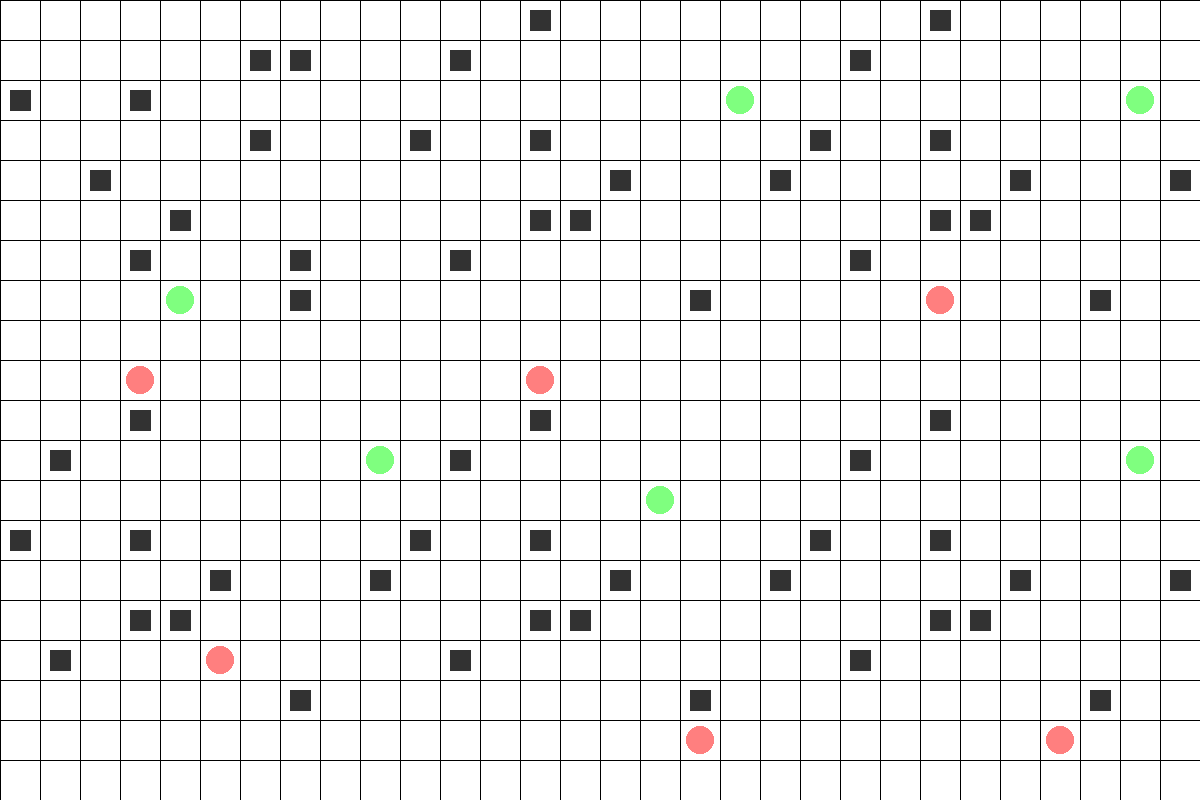
1 predator vs 1 prey · 10×10 |
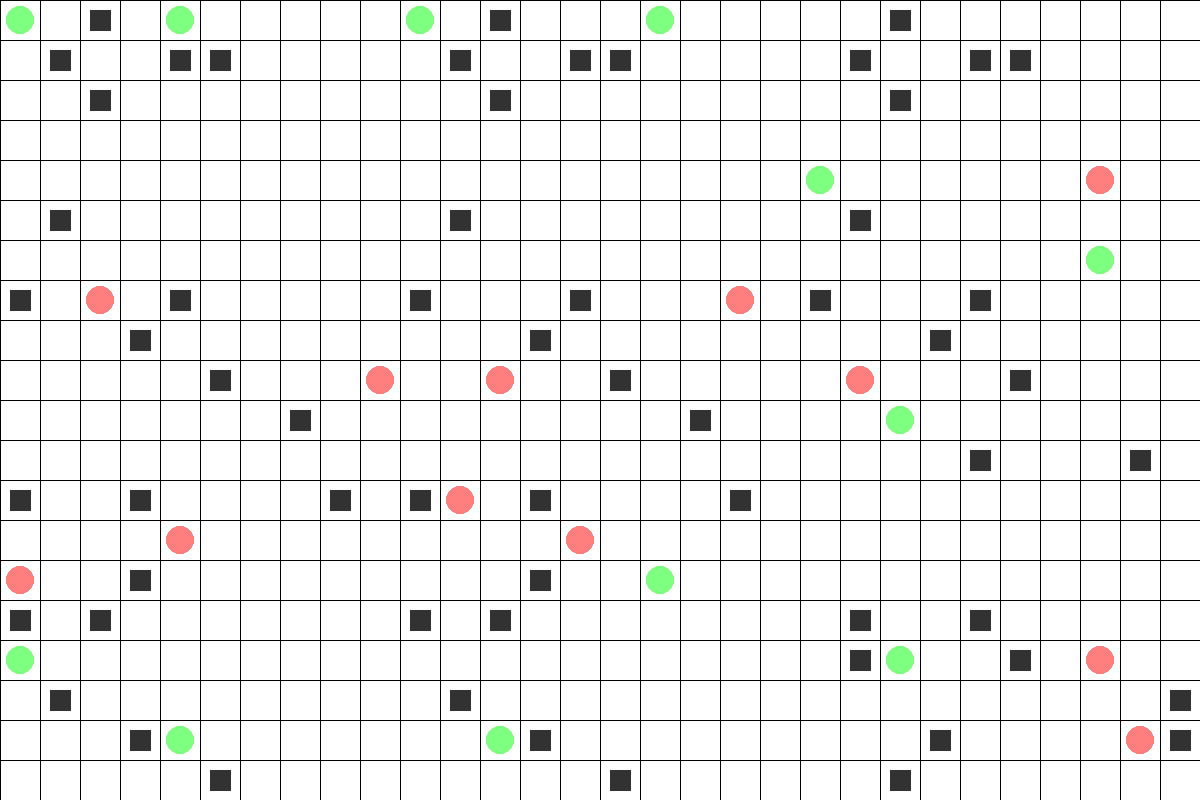
2 predators vs 2 prey at double speed · 10×10 speed/stamina via SpeedWrapper
|
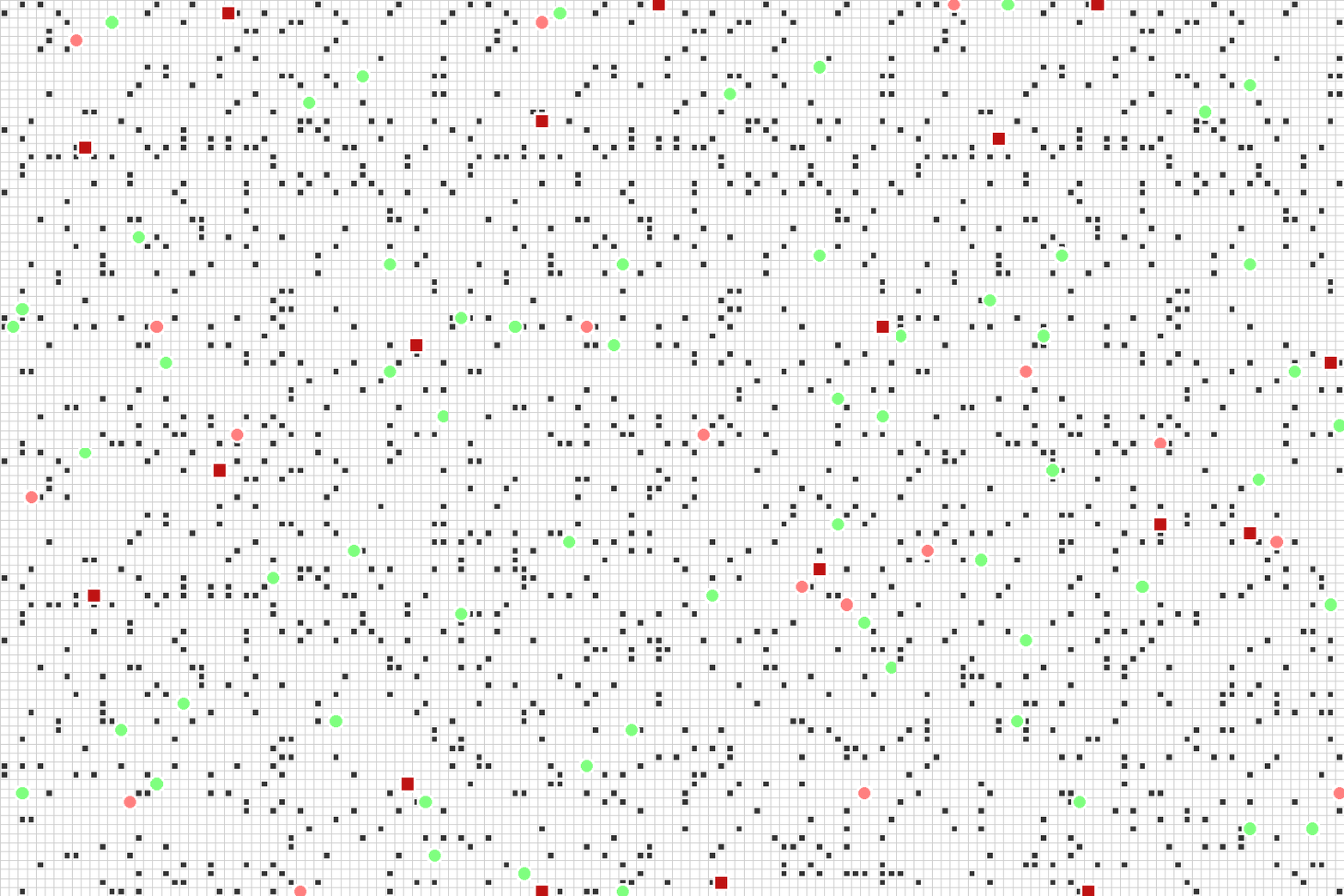
Two predator teams vs 10 prey · 50×50 cardinal movement (red) vs diagonal movement (pink) |
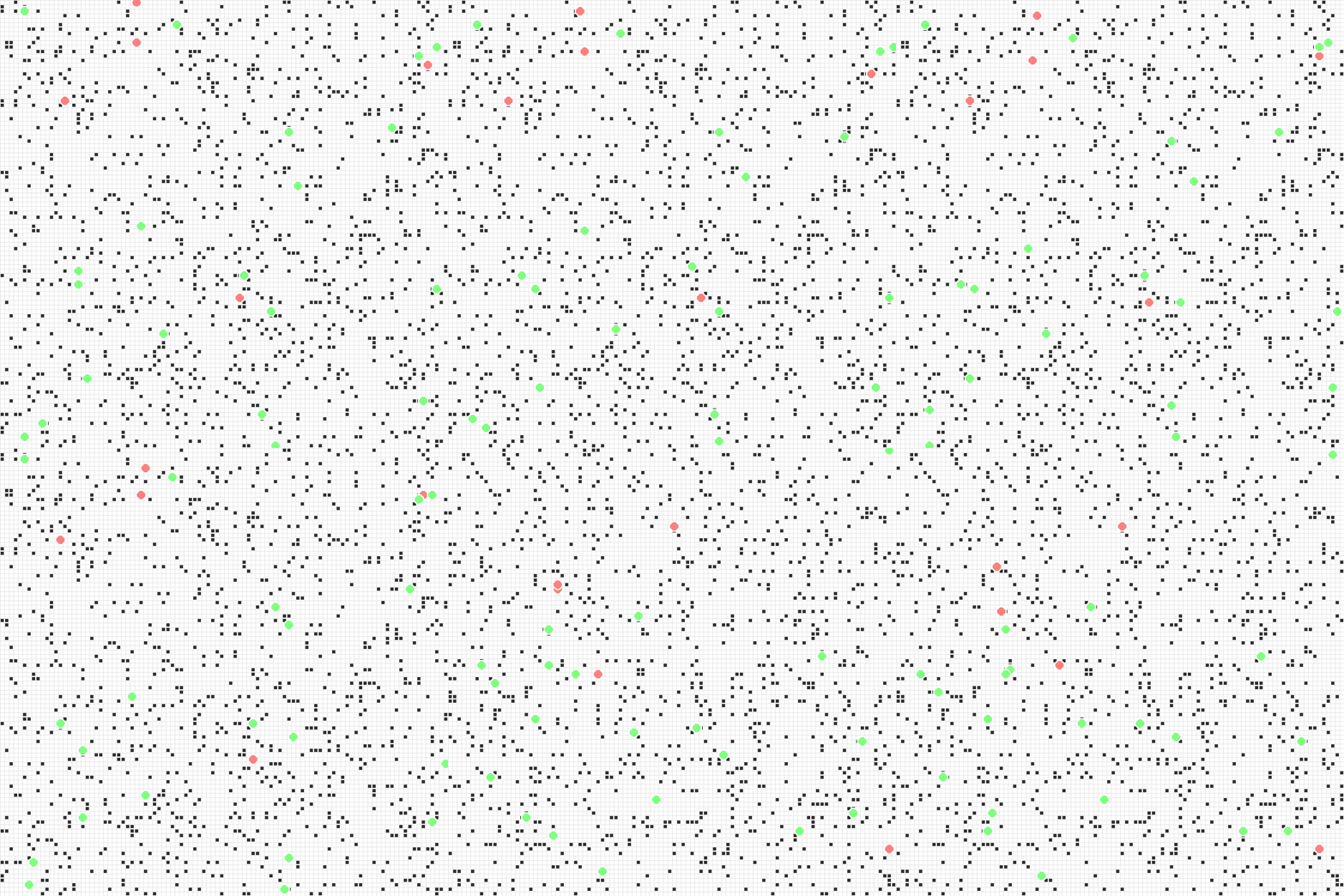
5 predators vs 20 prey · 100×100 1,000 obstacles |
Every clip runs at 10% obstacle density with untrained, uniformly random
actions: they show what the environment can be configured to express, not
learned behaviour, and each clip runs a few short episodes: an episode ends at
the first capture, then the next begins with a fresh layout. For the contrast,
the trained DQN pursuit on the landing page uses the same 1v1
roster and grid size as the first tile, at 20% obstacles and with a speed-2
predator. Colours and marker shapes are the
environment's own, from
Agent.get_agent_color() (predators on the red hue, prey on
green, with shade and shape separating subteams), and the two movement
geometries in the third clip are the shipped discrete_5 and cross action
spaces.
What is config and what is not
Grid size, populations, obstacle density, and per-agent speed/stamina are
all YAML keys, so the first, second, and fourth clips are pure
configuration. Assigning a different action space per team is not: the
core holds one global action_space_plugin, and the third clip composes
per-team geometry in the generator script through the core's per-agent
direction-map fallback. Making that YAML-selectable is not yet supported;
see the roadmap.
Regenerate the clips with python .github/scripts/make_showcase_gifs.py
(needs pip install -e ".[docs]").
The extension menu
Everything below is buildable today, with zero core changes. Difficulty is calibrated to a student audience (★ = a first contribution, ★★★ = a capstone or research project).
Observations ★–★★
- Noisy sensors ★ — seeded Gaussian jitter on distances; determinism is preserved because noise flows through the seeded generator.
- Field-of-view cones ★★ — agents see only a directional wedge.
- Line-of-sight occlusion ★★ — obstacles block vision.
- Frame-stacking memory ★★ — the last k observations, for partial-observability studies.
- Egocentric grid patch ★★ — a local grid patch flattened into the
fixed-length vector
encode()must return (a CNN consumer would also need a baseline that reshapes it).
Rewards ★–★★ (composable, so each is also an ablation)
- Shared-credit capture split ★ — co-located predators share the bonus.
- Time-decayed capture bonus ★ — faster captures worth more.
- Encirclement shaping ★★ — reward surrounding, not chasing.
- Energy costs ★★ — pair the stamina mechanic with a per-move penalty.
- Zero-sum mirroring ★ — prey receives the negation of predator reward.
Actions and wrappers ★–★★
- King moves ★ — 8-connected movement.
- Wait-and-observe ★ — an explicit information-gathering no-op.
- Momentum actions ★★ — repeating a direction is cheaper.
- Macro-actions ★★ — e.g. move-toward-nearest-prey as one action.
- Stochastic "slippery" dynamics belong in a wrapper (like
SpeedWrapper), keeping the core deterministic and the noise seeded.
Algorithms ★★–★★★
- Game-theoretic tabular learners ★★★ — JAL-GT (joint-action learning
that solves each stage game for an equilibrium; minimax-Q for the zero-sum
pursuit case, Nash-Q/correlated-Q as variants), JAL-AM (opponent modeling),
WoLF-PHC, fictitious play, hysteretic and lenient learners. These are the
heart of the MARL textbook literature and have few clean, inspectable
open-source implementations; PPAGE's fully visible joint state is their
natural habitat, and
CQL's joint Q-table is the in-repo precedent. - CTDE methods ★★★ — VDN- or QMIX-style value decomposition, provided per-agent state stays inspectable.
- Distributional or Double/Dueling ablations ★★ — extending the DQN family the way the existing flags do.
If you build one of these, start from the matching guide (custom observation, custom reward, custom action) and open a design issue first for anything algorithm-sized; the contribution rules are short.