Concept: GridWorld
What It Is
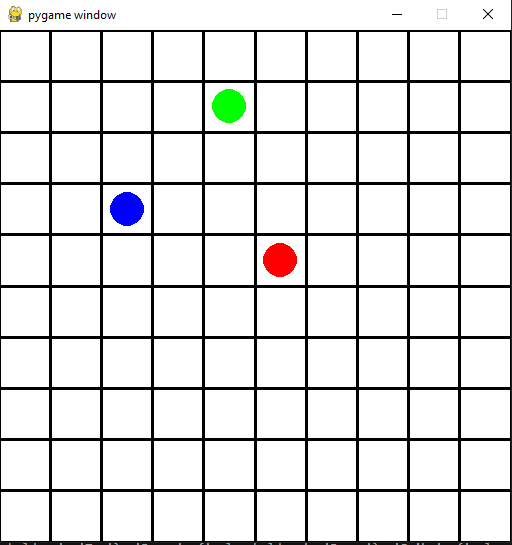
The GridWorld is a bounded 2D discrete grid — the physical substrate of the simulation. It owns the canonical state of the world: agent positions, obstacle positions, episode progress, and capture events.
It is implemented as GridWorldEnv in src/ppage/core/gridworld.py and inherits from gymnasium.Env.
State Model
At any point in an episode, the world state consists of:
| State Variable | Type | Description |
|---|---|---|
_obstacle_location |
List[np.ndarray] |
Fixed obstacle positions for this episode |
Each agent's _agent_location |
np.ndarray [x,y] |
Current position per agent |
_captured_agents |
List[str] |
Names of all prey captured so far (persistent) |
_captured_this_step |
List[str] |
Prey names captured in the current step only (reset each step) |
_capturing_predators |
set |
Predator names that made a capture this step (reset each step) |
_captures_total |
int |
Total capture events this episode |
_episode_steps |
int |
Timesteps elapsed |
capture_threshold |
int |
Captures needed to terminate (from config, default 1) |
max_steps |
int \| None |
Step limit before truncation (from config) |
The grid itself has no explicit array representation — positions are stored on agents and in the obstacle list, not in a 2D array.
Coordinate System
- Origin
[0,0]is top-left - X increases right, Y increases down
- Positions are
np.ndarray([x, y], dtype=int32) - Grid is
size × sizecells (square, configurable)
Invariants
These properties hold throughout any well-formed episode:
- No agent at an obstacle cell — obstacle placement skips agent start positions; moves into obstacle cells are rejected — but only while
block_agents_by_obstaclesistrue(the default); set itfalseinenv.yamland agents may enter obstacle cells - Captured agents do not move — once in
_captured_agents, an agent's position is frozen - All positions are in-bounds — the step loop
np.clips each axis independently, so an out-of-bounds component is clamped to the edge while the in-bounds component still applies (a diagonal move at a wall slides along it rather than being fully rejected) - Randomness flows through
self.rngonly — no global random state
allow_cell_sharingcontrols same-role stacking. With the defaulttrue, any agents may share a cell. Set itfalse(inenv.yaml) to forbid two same-role agents (two predators, or two prey) from occupying the same cell — a move onto a cell already held by a same-role agent is rejected. Predator–prey overlap is always allowed, so the capture mechanic (which is exactly such an overlap) keeps working either way.
Episode Lifecycle
reset()
  │  seed RNG
  │  place obstacles (random, avoiding agent positions)
  │  place agents (random, avoiding obstacles)
  │  zero episode counters
  └► return (initial_obs, info)

step() × N
  │  move all agents simultaneously
  │  detect captures
  │  compute rewards
  │  check termination
  └► return dict {"obs", "reward", "terminated", "truncated", "info"}

close()
  └► release Pygame resources
Physics Rules
Movement
- Each agent picks one action integer; the active
ActionSpaceplugin maps it to a[dx, dy]vector (defaultdiscrete_5: Right, Up, Left, Down, Noop — see concepts/actions.md for the other two shipped action spaces) - All moves are processed simultaneously (no ordering)
- Out-of-bounds → each axis is clipped independently (
np.clip), so only the offending component is cancelled; a diagonal move at an edge partially applies, sliding the agent along the wall - Obstacle cell → agent stays in place
- Captured agent → action ignored, position frozen
Capture
- After all moves are applied, the grid is scanned for cells containing both a predator and a prey
- If any such cell exists: prey is added to
_captured_agents - Multiple captures in one step are all processed
Termination
- Episode ends when
_captures_total >= capture_threshold(read fromenv.yaml → termination.capture_threshold) - Episode truncates when
max_steps is not Noneand_episode_steps >= max_steps
Extension Contract
The GridWorld is immutable. It exposes four injection points for plugins:
env.reward_fn             # callable(env) → Dict[str, float]
env.observation_builder    # callable(env) → Dict[str, dict]
env.observation_encoder    # callable(obs, env) → array-like — required by the neural baselines
env.action_space_plugin    # ActionSpace instance — .to_direction(int) → np.ndarray
All four are None at construction and must be set before calling step() (run_from_config.build_environment() wires them). They are read-only with respect to the environment — plugins may not modify env state through these calls.
run_from_config.build_environment() additionally wraps the fully-wired env in SpeedWrapper before returning it, so in practice most code interacts with a SpeedWrapper-wrapped GridWorldEnv, not the raw class. See concepts/wrappers.md, specs/observation-builder-spec.md, specs/reward-function-spec.md, and specs/action-space-spec.md for the per-plugin behavioral contracts.