Project Overview
Purpose
The Predator-Prey Archetype Gridworld is a discrete, deterministic multi-agent reinforcement learning (MARL) environment built as a controlled research testbed. Its primary purpose is to enable mechanistic study of coordination, pursuit-evasion, and emergent behavior in multi-agent settings without the confounding variables present in more complex simulators.
Research Goals
| Goal | Description |
|---|---|
| Reproducibility | All experiments are fully seeded and config-driven. Two runs with the same seed and config produce identical trajectories. |
| Interpretability | State and action spaces are small and enumerable. Every transition can be traced manually. |
| Modularity | Observation models, reward structures, and learning algorithms are independently swappable via YAML config—no code changes required. |
| Educability | The codebase is structured to teach students the separation between environment dynamics, perception, incentives, and learning. |
Scope
In scope: - Discrete grid-based multi-agent dynamics - Configurable predator and prey teams - Pluggable observation, reward, and action-space systems - Per-agent speed/stamina mechanics via wrappers - Tabular Q-learning baselines (IQL, CQL, MixedTrainer) and PyTorch baselines: DQN (including Double DQN and Dueling DQN), ActorCritic, A2C, and A3C - Pygame-based visualization
Out of scope: - Continuous state/action spaces - Advanced policy-gradient methods (PPO, SAC, MADDPG) — though on-policy actor-critic baselines (ActorCritic, A2C, A3C) do ship - Networked or distributed training - Photorealistic rendering
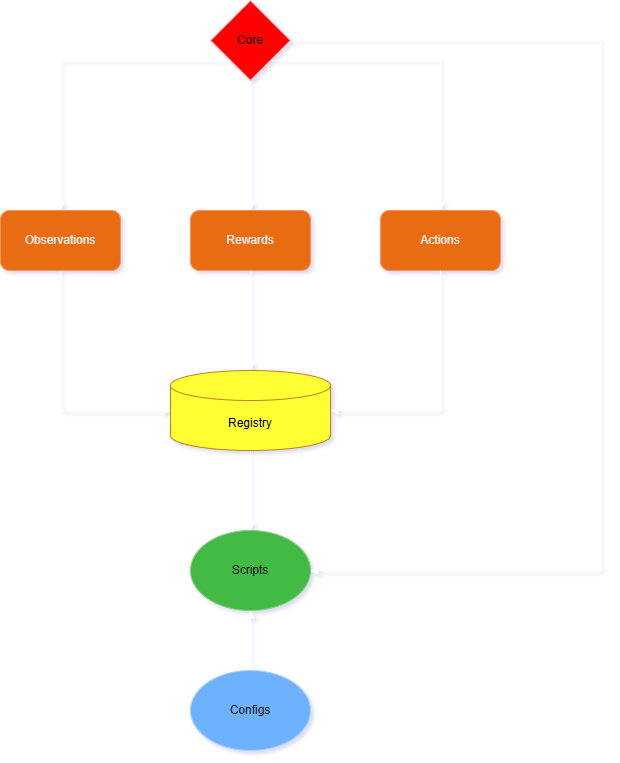
System at a Glance
┌─────────────────────────────────────────────────────────┐
│                    YAML Configuration                   │
│     env.yaml  agents.yaml  observations.yaml            │
│     rewards.yaml  actions.yaml  experiment.yaml         │
└────────────────────────┬────────────────────────────────┘
                         │ parsed by run_from_config.py
                         ▼
┌─────────────────────────────────────────────────────────┐
│                  Environment Layer                      │
│   GridWorldEnv  ←→  Agent (×N)                         │
│   (core/ — immutable)                                   │
│                                                         │
│  ┌────────────┐ ┌────────────┐ ┌───────────────────┐  │
│  │Observations│ │  Rewards   │ │  Action Spaces     │  │
│  │(5 builders)│ │(3 funcs)   │ │(3 spaces)          │  │
│  └────────────┘ └────────────┘ └───────────────────┘  │
│              ↓ wrapped by SpeedWrapper (speed/stamina) │
└────────────────────────┬────────────────────────────────┘
                         │ env.step() / env.reset()
                         ▼
┌─────────────────────────────────────────────────────────┐
│                  Baselines Layer                        │
│  IQL (tabular)  CQL (tabular, centralized)              │
│  MixedTrainer (per-team)  DQN (PyTorch, +Double/Dueling)│
│  ActorCritic  A2C  A3C (PyTorch, on-policy)             │
│   (ppage/baselines/ — extensible)                             │
└─────────────────────────────────────────────────────────┘
Key Design Invariants
-
core/is immutable.gridworld.pyandagent.pyare never modified by contributors. All variation comes through configuration and plugins. -
All randomness is seeded. The environment uses
np.random.default_rng(seed)exclusively. No global random state. -
Plugins are self-contained. Observation builders and reward functions are pure-ish: they read env state but do not modify it.
-
Config drives everything. If something cannot be expressed in YAML, it should probably be a new plugin, not a code change.